


What Is GEO (Generative Engine Optimization) and Why Your Alabama Business Needs It Now

If you’ve been paying attention to how people search online lately, you may have noticed something different happening.
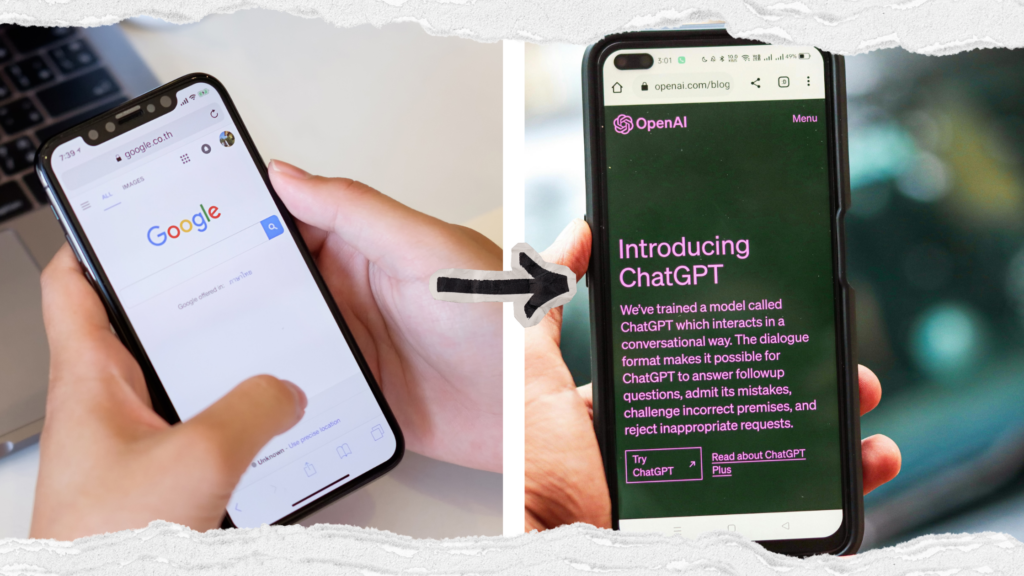
Google results now often open with a paragraph of AI-generated text summarizing an answer before any website links appear. People are typing questions into ChatGPT and asking it to recommend a local service provider. Customers are using Perplexity, Copilot, and Google’s AI Mode to research businesses before they ever visit a website.
This isn’t a trend on the horizon. It’s happening right now, and it’s changing what it means to be “findable” online in ways that most small business owners, including most businesses right here in Huntsville and Madison, Alabama, haven’t caught up to yet.
That’s where GEO comes in. And no, it has nothing to do with your physical location (though as you’ll see, your location is very much part of it).
What Is GEO?
GEO stands for Generative Engine Optimization. It’s the practice of structuring your content, your website, and your broader digital presence so that AI-powered search tools – ChatGPT, Google AI Overviews, Perplexity, Microsoft Copilot, and others – can find you, understand you, and cite you in the answers they generate for users.
Traditional SEO was about ranking. You optimized your pages so they appeared high in Google’s list of blue links. The goal was a click, getting someone to visit your website.
GEO is about citation. When someone asks an AI tool a question, the AI synthesizes an answer from multiple sources and may or may not show links at all. To be part of that answer, your content and your business information need to be structured in a way these tools can read, trust, and pull from.
Think of it this way: SEO puts you on the shelf. GEO gets you recommended by the librarian.
Why This Matters Right Now – With Real Numbers
This shift is further along than most people realize.
A 2025 study by Whitespark found that AI Overviews, Google’s AI-generated answer blocks, were appearing in 68% of local searches. That means when someone in Huntsville searches for a local service, more than two-thirds of the time they’re seeing AI-generated content above the traditional list of websites.
A separate analysis found that organic click-through rates for search results that include an AI Overview fell by 61%. The AI answers the question well enough that many people never click through to a website at all. Bain & Company research found that nearly 60% of searches now end without a click.
Meanwhile, AI-referred traffic to business websites grew by over 1,200% between mid-2024 and early 2025, according to Adobe Analytics. The businesses that are being cited and recommended by AI tools are seeing a new stream of visitors, from sources that didn’t exist 18 months ago.
Here’s the number that should really get your attention: a 2026 study auditing thousands of local business listings found that AI search tools recommend only about 1.2% of local businesses, the overwhelming majority are completely invisible to these platforms.
That’s where your local competition currently stands. And that gap is an opportunity.
GEO vs. SEO: Do You Have to Choose?
No. And this is important to understand.
GEO doesn’t replace SEO, it builds on top of it. The fundamentals of good SEO (clear structure, quality content, fast-loading mobile site, strong Google Business Profile, consistent citations across the web) are also the foundation of good GEO. If you’ve invested in SEO, you’re already partway there.
What GEO adds is a layer of intentional optimization for how AI tools specifically read and interpret content. Here’s what that looks like in practice:
Content structure: AI tools favor content that is clearly organized, with direct answers to specific questions. Headings should be descriptive. Questions should be answered in the text near where they’re asked, not three paragraphs later.
Entity clarity: AI models think in entities, clearly defined things (people, businesses, services, locations) that they can confidently identify and reference. The more consistently your business name, location, services, and identity appear across your website, your Google Business Profile, your citations, and third-party mentions, the more confidently AI tools can recommend you. Fragmented or inconsistent information makes AI hedge, or skip you entirely.
E-E-A-T signals: E-E-A-T stands for Experience, Expertise, Authoritativeness, and Trustworthiness, a framework Google developed for evaluating content quality. It’s now central to how AI tools decide what to cite. Content that demonstrates real expertise, includes verifiable specifics, cites credible sources, and clearly identifies the author behind it performs significantly better in AI-generated responses.
Conversational content: People ask AI tools questions the way they’d ask a knowledgeable friend. “What’s the best website platform for a small business?” “What should I set up for local SEO before I launch?” Content that directly answers these kinds of naturally-phrased questions is far more likely to be pulled into AI responses than content written purely around keyword density.
Schema markup: This is the structured data code on your website that formally tells AI tools and search engines what your business is, where it’s located, what services you offer, and how to contact you. It’s one of the clearest signals you can send to any AI system that’s trying to build a picture of your business.
What This Means for Local Businesses in Alabama
Here’s the nuance that matters for Huntsville and Madison-area businesses specifically.
Early data suggests AI Overviews apply the same quality and authority-based criteria regardless of city size. A well-structured, authoritative piece of content from a local business in Madison, Alabama can compete with content from a business in Chicago or New York, because AI tools are evaluating content quality and relevance, not just domain authority and inbound links.
This is genuinely good news for local small businesses. The playing field is more even in AI search than it ever was in traditional SEO, where large national brands and media sites with massive link profiles could dominate local results.
The businesses that will win in AI search over the next few years aren’t necessarily the biggest or longest-established. They’re the ones who move now, who structure their content intentionally, build a consistent digital footprint, and create the kind of specific, useful, locally-relevant material that AI tools can confidently cite and recommend.
Most of your local competitors haven’t thought about this yet. That window is closing, but it isn’t closed.
Practical GEO Wins for a Small Business Right Now
You don’t need an enterprise budget or a dedicated marketing team to start improving your GEO. Here’s where to focus first:
1. Audit your Google Business Profile. Make sure every field is complete, accurate, and fully matches what’s on your website. This is one of the primary sources AI tools pull from for local business recommendations.
2. Add an FAQ section to key service pages. Write out the questions your clients actually ask you — in the natural way they’d ask them, and answer them directly on your service pages. This is one of the highest-return GEO tactics available, and almost no local businesses in this market are doing it well.
3. Write content that answers specific questions. Blog posts like this one, that directly answer a real question someone might ask an AI tool, are exactly the kind of content that earns AI citations. Specificity matters. “Website design services in Huntsville, AL” is a keyword. “How much does a Showit website cost in Alabama?” is a GEO-optimized answer.
4. Be consistent everywhere. Your business name, address, phone number, and service descriptions should be identical across your website, Google Business Profile, Yelp, Apple Maps, and every other directory where you appear. Inconsistency is one of the fastest ways to undermine your credibility with AI systems.
5. Establish authorship. AI tools favor content from identifiable, credible humans. Author bios, LinkedIn profiles, and any third-party mentions or features (local press, industry publications, podcast appearances) all build the kind of author authority that GEO rewards.
This Is Already Part of What I Do at PiperMache
If you’ve been following along with this blog or you’re familiar with my website, you may have noticed I’ve already been talking about AI visibility for a while. It’s on my homepage, I teach about it to small groups, and it’s part of how I approach every web design and SEO project.
That’s not an accident. I’ve been watching this shift develop for the past couple of years, and I’ve been building GEO principles into my clients’ websites and SEO strategies ahead of the curve. The businesses I’ve worked with that have strong content foundations, clean site structure, optimized Google Business Profiles, and consistent citations across the web are already better positioned for AI visibility than most of their local competitors.
The good news is that if your website was built with a marketing strategy behind it, not just aesthetics, the foundation for GEO is already there. We’re building on what you have, not starting over.
The Honest Bottom Line
GEO is not hype. The data is real, the shift is measurable, and the businesses that pay attention now will hold a meaningful advantage for years over those that don’t.
At the same time, traditional SEO isn’t dead. Google hasn’t gone anywhere. 95% of Americans still use traditional search every month. What’s changed is that search now has more layers, and being visible in all of them requires a more intentional approach than it did three years ago.
If you’re a business owner in Huntsville, Madison, or anywhere in North Alabama, and you want to understand where your website currently stands in terms of AI visibility, and what it would take to actually show up in ChatGPT, Perplexity, and Google AI Overviews when someone in your market asks for what you do, that’s exactly the kind of conversation I love having.
Reach out! Let’s talk about what AI visibility looks like for your specific business.
Frequently Asked Questions About GEO
What does GEO stand for?
GEO stands for Generative Engine Optimization, the practice of optimizing your content and digital presence so AI-powered search tools like ChatGPT, Google AI Overviews, and Perplexity cite and recommend your business in their answers.
Is GEO the same as SEO?
No, but they’re closely related. GEO builds on traditional SEO foundations and adds a layer of optimization specifically for how AI tools parse, interpret, and cite content. A strong SEO foundation is the starting point for GEO.
Does GEO matter for local businesses?
Yes — and potentially more so than for national brands. AI tools evaluate content quality and relevance rather than purely domain authority, which means a well-structured local business website can compete with large brands in AI-generated responses in ways that were much harder in traditional search.
How long does GEO take to work?
Like traditional SEO, GEO is a long-term strategy that compounds over time. That said, improvements to content structure, Google Business Profile optimization, and schema markup can produce measurable improvements in AI visibility faster than many traditional SEO tactics.
How do I know if my business is showing up in AI search?
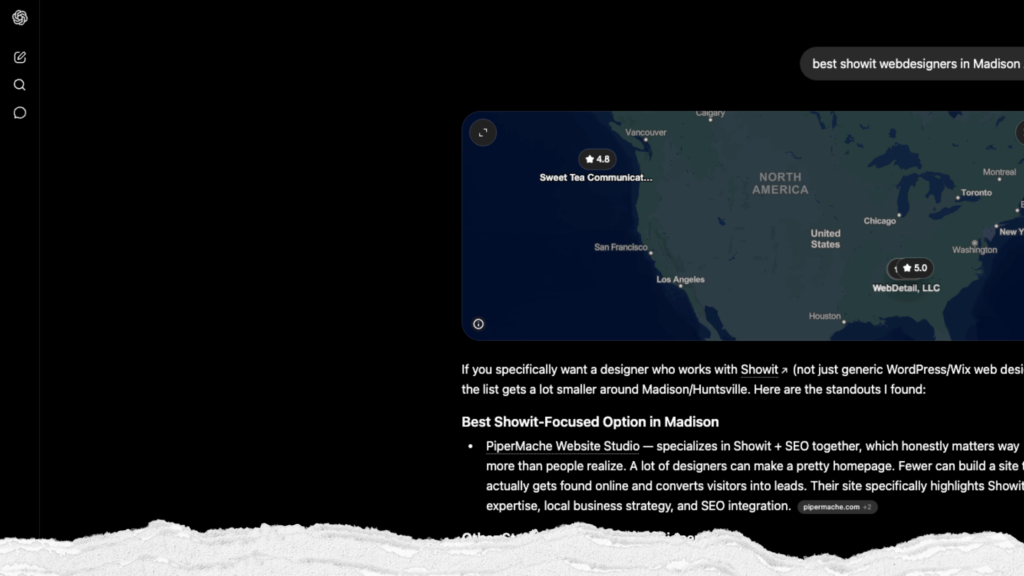
Start by testing it yourself. Open ChatGPT or Perplexity and ask: “Who are the best [your service] providers in [your city]?” If your business doesn’t appear, you have a GEO gap worth addressing.
PiperMâché is a custom website design and SEO studio based in Madison, AL, serving small businesses throughout the Huntsville metro area. Specializing in Showit, Shopify, and WordPress websites — and forward-thinking SEO strategies that include AI visibility.



Comments Off on What Is GEO (Generative Engine Optimization) and Why Your Alabama Business Needs It Now