


TL;DR
- Building local citations, connecting Google Analytics, optimizing for mobile, and creating individual pages for each service are the steps that compound into long-term local visibility.
- Local SEO isn’t something you add after launch — it’s the foundation that determines whether Google can find and show your business to the right people.
- New Huntsville businesses should set up their Google Business Profile, add location-specific content to their website, and submit to Google Search Console before going live.
Starting a business in Huntsville is exciting. You’ve got your name, your city business license, maybe even your logo. You’re building your website. You’re getting close to launch day.
And then someone asks: “Are you set up for SEO?”
Blank stare.
Here’s the truth most people don’t tell new business owners: SEO isn’t something you bolt on after launch. It’s the foundation; the stuff that actually determines whether Google can find you, understand you, and show you to the right people, and it needs to be in place from day one. Or as close to day one as possible.
I’ve helped new businesses across Huntsville, Madison, and North Alabama set up their digital presence from scratch, and the same gaps come up every single time. This post walks you through exactly what to set up before (or immediately after) you launch – in plain language, with no technical jargon required.
Why Local SEO Is Different for New Businesses
General SEO and local SEO are related, but they’re not the same thing.
General SEO is about getting your website to rank for broad search terms: “website designer,” “pet groomer,” “bookkeeper.” These keywords are competitive, national, and take months or years to crack.
Local SEO is about getting found by the people who are already near you and already looking for what you do. When someone in Huntsville types “hair salon near me” or “tax prep Madison Alabama,” Google is making real-time decisions about which businesses to show. Those decisions are based on specific local signals, your Google Business Profile, your website’s location mentions, your citations across the web, and more.
For a brand-new business, local SEO is your fastest path to visibility. You don’t need to outrank national competitors. You just need to outrank the other businesses in your zip code. And many of them have neglected their local SEO for years.
The Local SEO Setup Checklist for New Huntsville Businesses
1. Claim and Complete Your Google Business Profile
This is the single most important thing you can do for local visibility, and it’s completely free.
Your Google Business Profile (formerly Google My Business) is what powers the map results — the “local pack” that shows three businesses with a map when someone searches for a local service. If you’re not in that box, you’re largely invisible for local searches.
To show up, you need to:
- Claim your profile at business.google.com (or create one if it doesn’t exist yet)
- Choose the right primary category — this matters more than most people realize. “Website designer” and “Internet marketing service” are different categories with different audiences.
- Write a keyword-rich business description that mentions your city, your services, and who you help
- Add your exact address or service area — if you’re service-area based (you go to clients), you can set a radius without publishing a home address
- Upload real photos — your storefront, workspace, headshot, and examples of your work
- Get your first reviews — even 5 genuine reviews from happy early clients makes a significant difference in how Google ranks you
One thing I always tell new clients: be consistent. The name, address, and phone number on your Google Business Profile must exactly match what’s on your website. Even small differences (like “Street” vs. “St.”) create confusion for search engines and quietly hurt your local rankings.
2. Add Location-Specific Content to Your Website
Your website needs to clearly communicate where you are and who you serve — not just in the footer, but woven naturally throughout your content.
This means:
- Your city and service area in your page titles and headers. Not just “Web Designer” — “Web Designer in Huntsville, AL.”
- A dedicated contact or location page that includes your full address (or service area), embedded Google Map, phone number, and hours.
- Mentions of local neighborhoods, landmarks, or community context where it fits naturally. Referencing that you serve businesses near Research Park, in downtown Huntsville, or throughout Madison County signals to Google that your content is genuinely relevant to local searches.
- Schema markup (structured data) that formally tells Google your business name, address, phone number, and category in a format it can parse quickly. Your web designer should handle this — it’s technical, but essential.
Think of your website as your digital storefront address. If you walked into a random building with no signage telling you where you were, you’d be confused. Google feels the same way about a website with no location signals.
3. Submit to Google Search Console
Google Search Console is a free tool that lets you tell Google your website exists and ask it to start crawling your pages. Without it, Google will eventually find you on its own — but it could take months.
When I set up a new client’s website, submitting to Google Search Console is one of the first things I do. You’ll:
- Verify ownership of your website
- Submit your sitemap (a map of all your pages that helps Google index them faster)
- Monitor for errors — broken pages, mobile issues, indexing problems — so you can fix them early
This step alone can shave weeks off how long it takes for your site to start appearing in search results.
4. Connect Google Analytics
Search Console tells you how Google sees your site. Google Analytics tells you how people use your site — where they’re coming from, which pages they visit, how long they stay, and where they drop off.
For a new business, this data is gold. You’ll know within the first few months which services people are most interested in, whether your contact page is converting, and whether your traffic is actually coming from Huntsville or from somewhere random.
Set this up before you launch so you’re capturing data from day one. Trying to reconstruct traffic patterns six months in isn’t possible — that data is gone.
5. Build Your Local Citations
A “citation” is anywhere online that lists your business name, address, and phone number (called NAP — Name, Address, Phone). Citations on reputable directories signal to Google that your business is real, established, and consistent.
The most important ones for a new Huntsville business:
- Yelp — even if you don’t think your industry uses it, Google reads Yelp listings
- Bing Places for Business — yes, people still use Bing, and the Maps integration matters
- Apple Maps — critical if your clients use iPhones
- BBB (Better Business Bureau)
- Chamber of Commerce — Madison Chamber and Huntsville/Madison County Chambers are great options, and any industry-specific chambers relevant to your field
- Industry-specific directories — Houzz for home services, Healthgrades for healthcare, Avvo for legal, etc. In my case, Creative Designer Directory is one of them, for example.
The key, again, is consistency. Every listing needs to use the exact same business name, address, and phone number. This isn’t glamorous work, but it’s the kind of thing that compounds quietly over months into meaningful local authority.
6. Optimize for Mobile and Page Speed
This one bridges SEO and web design, but it belongs on every local SEO checklist.
Google uses mobile-first indexing, meaning it evaluates the mobile version of your website first when deciding how to rank you. If your site loads slowly on a phone, or if buttons are hard to tap, or if text is tiny and hard to read, you’re being penalised in ways you can’t see.
For a new website, this means:
- All images should be compressed and properly sized before upload
- Your site should load in under 3 seconds on a mobile connection
- Buttons and CTAs (call-to-action elements) should be easy to tap with a thumb
- Your phone number should be clickable, tapping it should dial directly
If you’re working with a designer, ask specifically about mobile performance and page speed optimization. It should be part of every new website build, not an add-on.
7. Start With at Least One SEO-Optimized Page Per Service
Many new business websites launch with a single “Services” page that lists everything they offer in a few bullet points. From an SEO standpoint, this is a missed opportunity.
Each core service you offer deserves its own dedicated page, written with:
- A clear, keyword-rich title (e.g., “Bookkeeping Services for Small Businesses in Huntsville, AL”)
- A description that answers the questions your ideal client is actually Googling
- Local context that connects the service to your market
- A clear call to action
You don’t need to write all of these before launch — one strong page per service is enough to start. But “start” is the keyword. The sooner these pages exist, the sooner they start accumulating search authority.
What Happens If You Skip This?
Nothing dramatic. Your website will still exist. People will still be able to find it if they know to look for it.
But you’ll miss the window. The first few months after a business launches are an important signal to Google — it’s watching to see if your business is active, getting reviews, generating clicks. If you launch with no local SEO foundation, you start that clock without any momentum behind it.
The business owners I’ve worked with who got their local SEO right from the beginning consistently show up in local searches faster, get found by more organic leads, and don’t have to rely as heavily on paid ads to stay visible.
One of my clients — a new service-based business in the Huntsville area — came to me specifically for SEO setup at launch. Within a few months, she was ranking for her primary service keywords locally, all from the foundational work we did before her site went live.
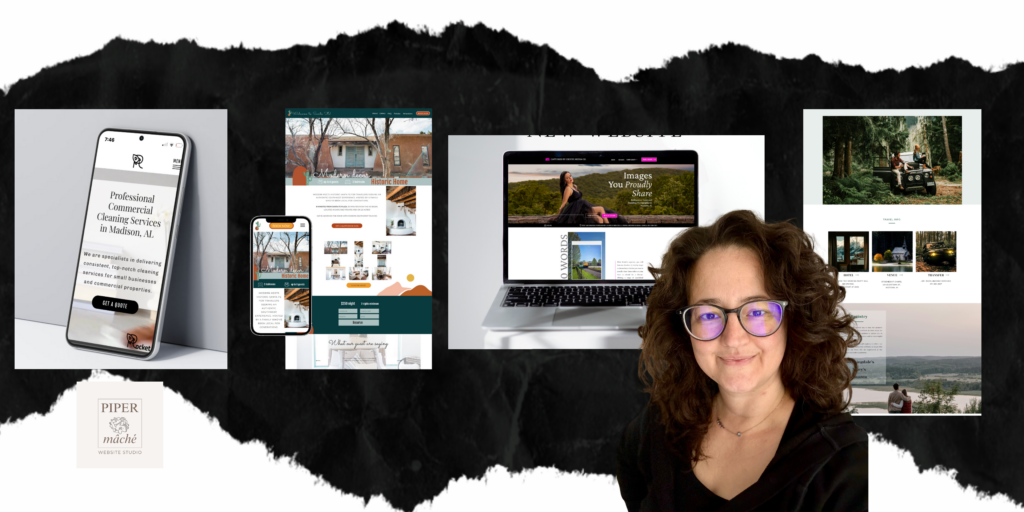
Don’t Want to Do This Yourself?
Good news: you don’t have to.
At PiperMache, I offer SEO setup services specifically for new businesses, covering everything from setting up your Google Business Profile optimization and Google Search Console submission to on-site keyword strategy and citation building. You launch with the foundation already in place, which means search engines can find you from day one instead of day 90.
If you’re opening a new business in Huntsville, Madison, or anywhere in North Alabama and want to make sure your online presence is set up the right way, before you start paying for ads or wondering why no one’s calling — let’s talk.
Reach out at pipermache.com and let’s get your digital foundation right.
PiperMâché is a custom website design and SEO studio based in Madison, AL, serving small businesses throughout the Huntsville metro area. Specializing in Showit, Shopify, and WordPress websites.



Comments Off on Local SEO for New Businesses in Huntsville, AL: What to Set Up Before You Launch